Many parents are surprised by how early we like to see children. The first visit is not about treatment. It is about checking that teeth are developing well, spotting early decay, giving parents practical advice, and letting your child meet the dentist when nothing hurts.
Children who start early are much less likely to be afraid of the dentist later, and much less likely to need treatment for pain.
When to book the first visit
Bring your child in when their first tooth appears, or by their first birthday, whichever comes first. This is the recommendation of the American Academy of Pediatric Dentistry and the NHS, and it is what we recommend at DentRW.
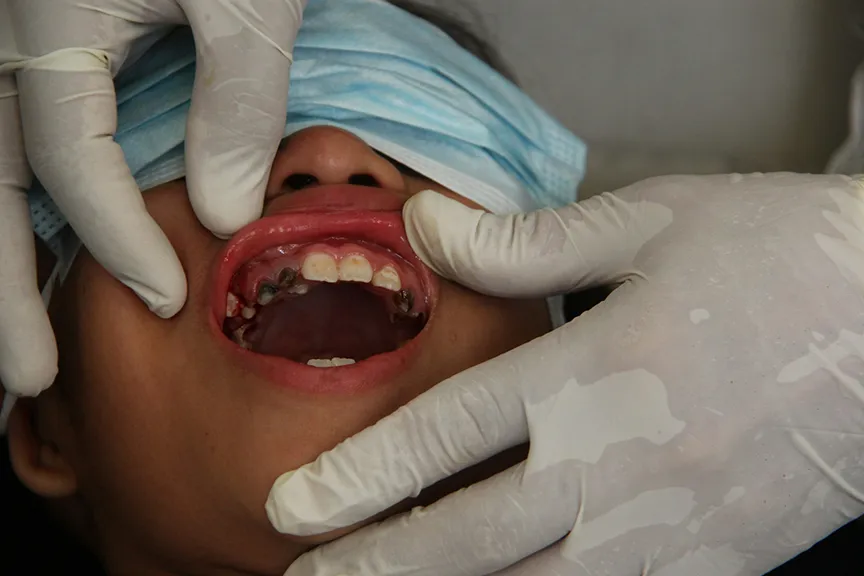
Come sooner if you notice white chalky patches or brown spots on the teeth, if your child has had a fall that hit the mouth, or if you are worried about anything you see.
What happens at the first appointment
A first visit at DentRW is short, gentle and relaxed. For babies and toddlers, the check is often done with your child sitting on your lap, facing you, while the dentist looks from behind. Dr. Agathe Mukamana, our paediatric dentist, will:
- Look at your child's gums, teeth, tongue and bite
- Check for early signs of decay, such as white chalky lines near the gumline
- Show you how to brush your child's teeth, and how much toothpaste to use
- Talk about feeding, bottles, snacks, dummies (pacifiers) and thumb-sucking
- Answer your questions and agree when to come back
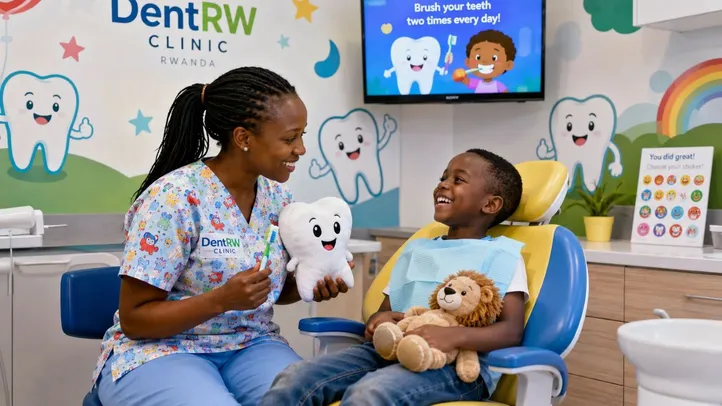
Parents are always welcome in the treatment room. We use a tell-show-do approach: we explain each step in child-friendly words, show your child the tool, then do it, at your child's pace.
Brushing and toothpaste, age by age
Fluoride toothpaste is one of the most effective ways to prevent decay in children. The amount matters, so check the tube for the fluoride level (ppm).
| Age | Toothpaste | Who brushes | Good to know |
|---|---|---|---|
| Before teeth | None | Parent | Wipe the gums with a clean, damp cloth after feeds |
| First tooth to age 3 | A smear of fluoride toothpaste, at least 1,000 ppm | Parent brushes, twice a day | Brush last thing at night; do not let children lick paste from the tube |
| Ages 3 to 6 | A pea-sized amount, 1,000 to 1,500 ppm | Child brushes, parent supervises and finishes | Spit, don't rinse |
| Age 7 and over | A pea-sized amount of family toothpaste, 1,350 to 1,500 ppm | Child brushes; parent checks | Start cleaning between teeth that touch |
Protecting teeth from decay
- Do not put your child to bed with a bottle of milk, formula, juice or sweet tea. Liquid pools around the teeth all night.
- From about six months, introduce a free-flowing cup, and aim to move away from the bottle around the first birthday.
- Give water or plain milk between meals. Keep juice, soda and sweet tea to mealtimes, if at all.
- Keep sweets and biscuits to mealtimes rather than as snacks through the day.
- Do not share spoons or clean a dummy in your own mouth. It passes decay-causing bacteria to your child.
Our article on diet and dental health has more ideas for tooth-friendly snacks.
Sealants and fluoride varnish
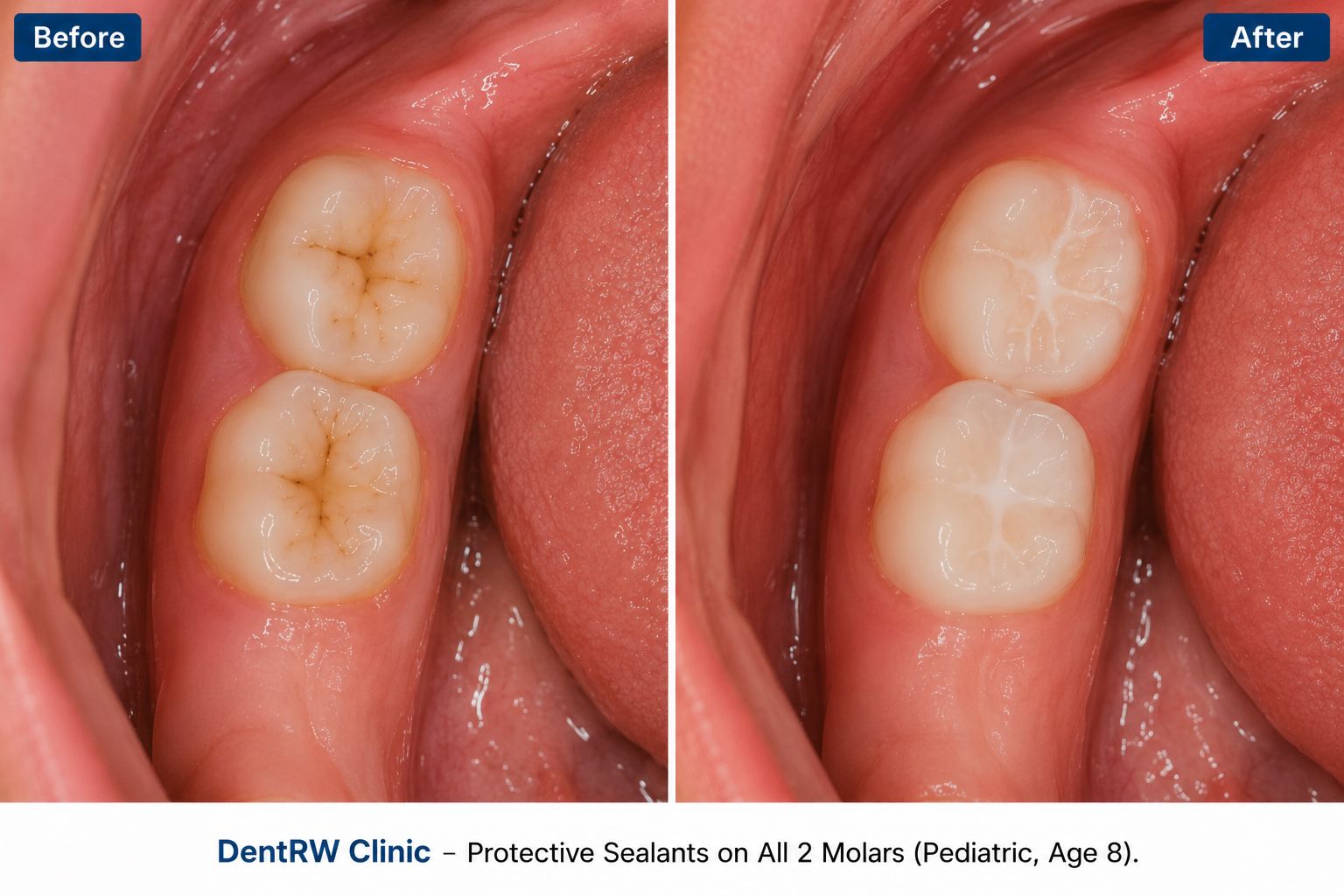
The chewing surfaces of back teeth have deep grooves that trap food and are hard to clean. Fissure sealants are a thin protective coating painted into those grooves. They are quick and painless, need no injection, and are usually placed when the first permanent back teeth come through (around age 6 or 7) and again when the rest arrive (around 11 to 14). They can protect for several years and are checked at each visit.
Fluoride varnish is painted onto the teeth in a few seconds and strengthens enamel. From the age of three, children benefit from it at least twice a year, and younger children may need it if they are at higher risk of decay.
Why baby teeth matter
Baby teeth are not "just temporary". Children need them to chew, speak clearly and smile with confidence, and each one holds the space for the adult tooth underneath. A baby tooth lost early to decay can let neighbouring teeth drift, leaving too little room and causing crowding that later needs braces. A badly decayed baby tooth can also become infected and damage the adult tooth forming below it.
An orthodontic check around age 7
By about age seven, most children have a mix of baby and adult teeth, and problems with the bite or jaw growth start to show. The American Association of Orthodontists recommends a first orthodontic check by this age. Most children do not need treatment yet, but finding a problem early can make later treatment simpler. Dr. Agathe provides early orthodontic assessment as part of routine children's visits.
Helping a nervous child
- Talk about the visit calmly and positively in the days before. Children pick up on a parent's worry.
- Avoid words like "hurt", "needle" and "drill". Never use the dentist as a threat.
- Play "dentist" at home: count your child's teeth with a toothbrush, then let them count yours.
- Bring a favourite toy or comfort object, and book a time when your child is usually rested and fed.
- Tell us when you book if your child is anxious, so we can allow extra time.
If your child cries or does not want to open their mouth, that is fine. We see it every day. We will pause, go at their pace, and try again another time if needed. The goal of the first visits is simply a positive experience.
Ready to book? Choose a time online or learn more about paediatric dentistry at DentRW.
Frequently asked questions
At what age should my child first see a dentist?
When the first tooth appears, or by the first birthday, whichever comes first. Come sooner if you notice spots on the teeth or your child has hurt their mouth.
How much toothpaste should my child use?
A smear of fluoride toothpaste (at least 1,000 ppm) from the first tooth to age 3, and a pea-sized amount (1,000 to 1,500 ppm) from 3 to 6. From 7, a pea-sized amount of family toothpaste (1,350 to 1,500 ppm).
Are dental X-rays safe for children?
Yes. We use digital X-rays, which use a very small amount of radiation, and we only take them when they are needed to find something we cannot see.
Do baby teeth with cavities need filling if they will fall out anyway?
Often yes. Some baby back teeth stay until age 10 to 12. A decayed baby tooth can cause pain and infection, and losing it early can cause crowding of the adult teeth. We explain the options for each tooth.
Can I stay with my child during the appointment?
Yes. Parents are always welcome in the treatment room, and for young children the check is often done on your lap.
Sources
- 1.Taking care of children's teeth (opens in a new tab), NHS
- 2.Parent resources: frequently asked questions (opens in a new tab), American Academy of Pediatric Dentistry
- 3.When should my child see an orthodontist? (opens in a new tab), American Association of Orthodontists
- 4.Tooth decay (opens in a new tab), NHS
This article is for general information and does not replace advice from a dentist who knows your health history.